
OPENING THE INNER CORE: THE CERAMICS OF HEIKEDINE GÜNTHER
Heikedine Günther’s ceramic works unfold as a natural extension of an artistic inquiry that has shaped her practice for decades. Internationally recognised for her paintings centred on the motif of the Core, she brings to clay the same sustained attentiveness to interior states, transformation, and material presence. Based in Switzerland and working across painting, printmaking, and sculpture, Günther began developing her ceramic practice in recent years through intensive self-directed research and close exchange with experienced ceramicists. The shift to clay introduced new conditions - slowness, resistance, and the irreversible effects of fire - requiring a different kind of material engagement and responsiveness. Rather than signalling a departure, Günther’s ceramics practice deepens her long-standing exploration of interiority, translating the Core from image into volume, from painted surface into spatial experience.
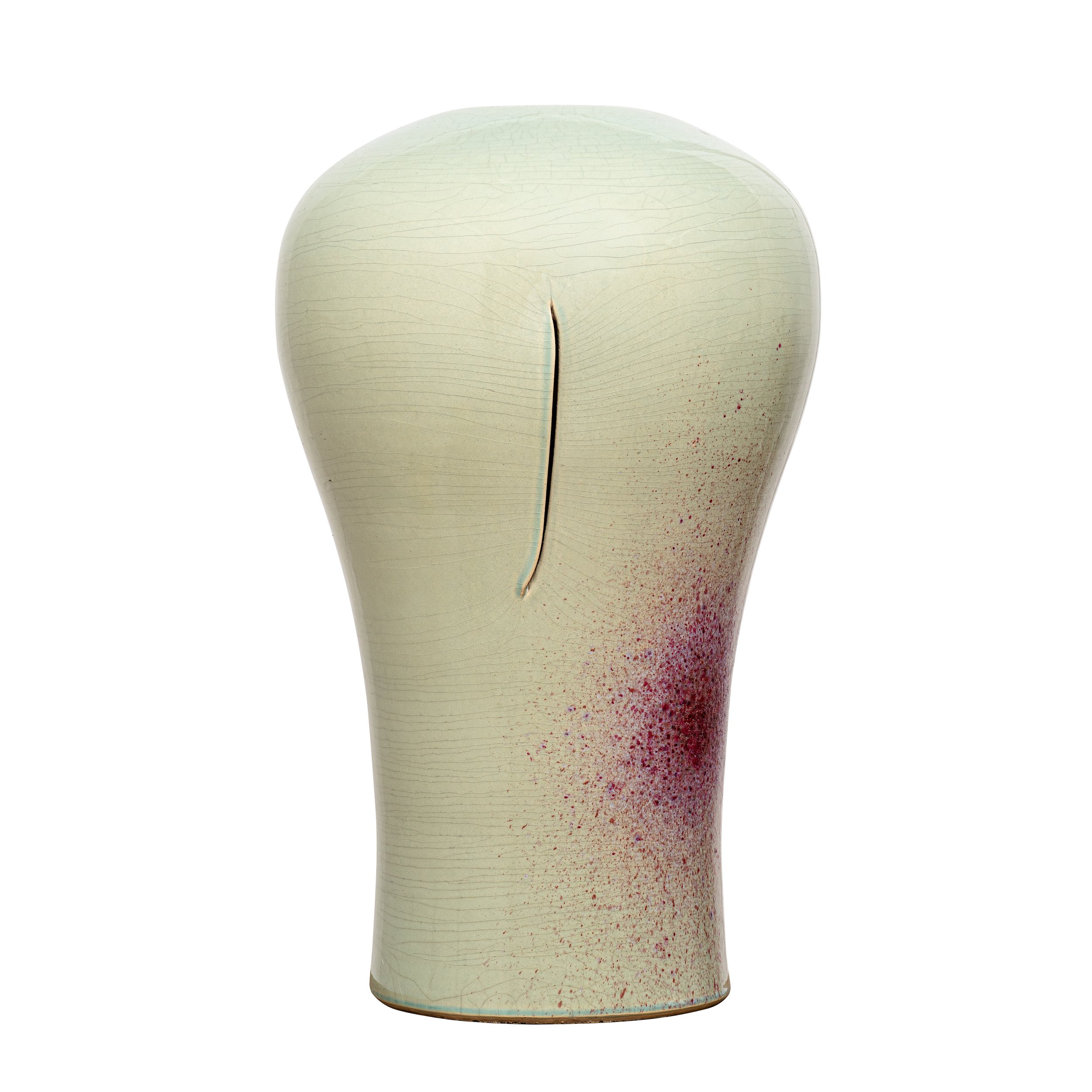
Core No. 2053
2025
Ceramic, Celadon Glaze, Gold
50 × 32 cm
Celadon as Cultural Bridge
Celadon is a key research area for Günther, and her large celadon sculptural forms appear, at first encounter, restrained and self-contained. Their surfaces are quiet, featuring a limited palette of fog-like greys, soft greens, and pale jade tones. This body of work is the result of sustained material research into both clay and glaze, and their volatile union in a kiln. Since 2023 Günther has been developing an extensive personal “library” of celadon tones. By spraying the glaze, she allows chance to enter the process: subtle runs, pooling, and softened edges emerge. Unlike painting, glazing operates as a form of intuitive “blind flight,” revealing its true colours only after firing. The process demands extensive testing, patience, and a willingness to fail - indeed forms are re-made multiple times before the desired form and colour is obtained.
Celadon’s origins lie in ancient China, where it was developed to emulate jade, a material associated with purity, prosperity, longevity, and status, and believed to bridge the earthly and divine. Over centuries, celadon spread across East Asia, evolving through local traditions while remaining a site of ongoing artistic innovation. Günther’s engagement with celadon is informed by long study, travel, and a personal devotion to East Asian art, philosophy, and ceramics. Rather than replicating historical forms, she translates their legacy into an original contemporary sculptural language. Her sculptures - ambiguous, planetary, and carefully proportioned - suggest both microcosmic and cosmic dimensions. Crackle on their surfaces records pressure, time, and transformation, embodying a fragile balance between control and openness.
CORE NO. 2053 features a celadon surface animated by a red blush. The "Sang de boeuf" (French for "ox-blood") glaze gets its distinctive deep red colour from copper oxide fired in an oxygen-starved kiln, a technically challenging process that often results in unique, varied effects. The glaze colour was only part of the challenge; the splatter application alone took a week of practice to master. As the artist notes, “you can only do it once, and it has to be right.”
The Slit as a Resonant Threshold
In many of Heikedine Günther’s ceramic works, a precise slit disrupts the expectation of a vessel as a functional container. The sculptural form - often recalling an inverted vase - is marked by a cut that functions as a metaphorical threshold, subtly unsettling symmetry and generating tension between containment and exposure. Its scale varies, from barely perceptible to wide enough for the gold-painted interior to glow outward. The gold evokes something precious and protected, transforming the interior into what the artist describes as an “innermost room.”
Günther understands the slit not as a rupture but as a membrane: a permeable zone in which interior and exterior enter into dialogue. This body of work reflects her philosophical concern with layers, contradictions, and transitions rather than fixed divisions. As she notes, “skin repels and absorbs. Light penetrates and reflects.” Importantly, the cut is not an aggressive gesture, political allusion or feminist statement. Neither does it bears any relation to Lucio Fontana’s slashed canvases. Instead, it serves as an invitation to commune with resonant inner forces.
These sculptures can be understood through the concept of resonance as articulated by the German sociologist, Hartmut Rosa. Resonance (according to Rosa) is a dynamic, responsive relationship between a person and the world in which both sides affect and transform each other. In this sense, Günther’s restrained colours and sculptural forms, with their tight slits and glowing interiors cultivate resonance as a quiet, reciprocal encounter grounded in attentiveness rather than spectacle or obvious revelation.
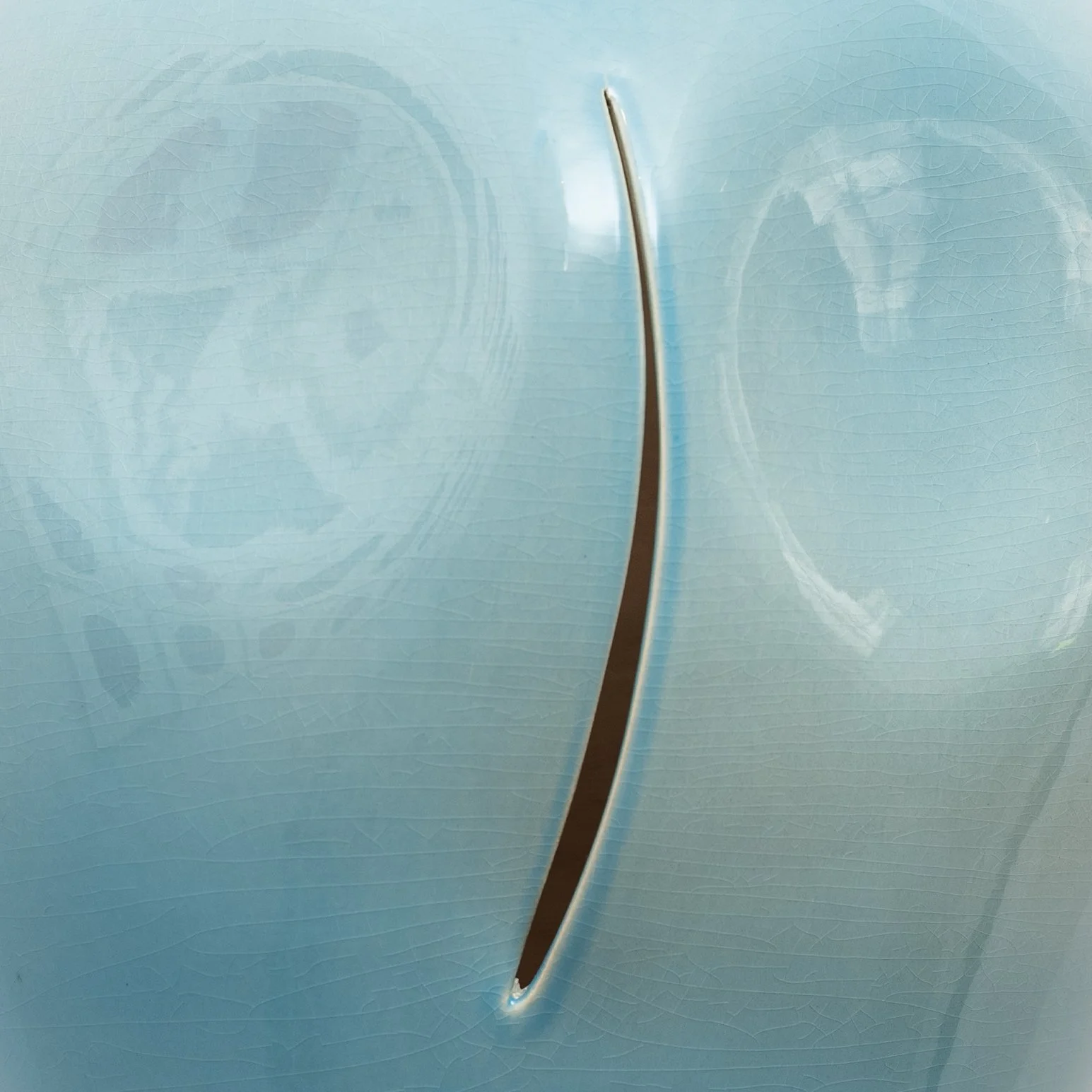
Core No. 2031
2025
Ceramic, Celadon Glaze, Gold
58 × 36 cm
Dialogue with the Paintings
Although ceramics and painting function differently, they remain deeply interconnected in Günther’s practice. Her paintings emerge from rotational body movements, built through layers of colour applied over a golden ground. They are expansive, intuitive, and optical. Ceramics, by contrast, are compact, resistant, and spatial. Yet both mediums revolve around the same concern: how inner energy takes form and emanates. In the paintings, the core radiates outward. In the ceramics, it withdraws inward. What the paintings disclose through luminescence, the ceramics evoke through a soft, restrained glassy translucence, asymmetry and rupture. Together, they form a dialogue between surface and volume, revelation and disclosure, and between seeing and sensing.
This duality allows Günther great flexibility in exhibition contexts. Ceramics and paintings can coexist, contrast, or stand independently, adapting to architectural space and curatorial framing. Each sculpture can be read as an individual presence, yet they also function powerfully as groups - fields of resonance rather than isolated objects.
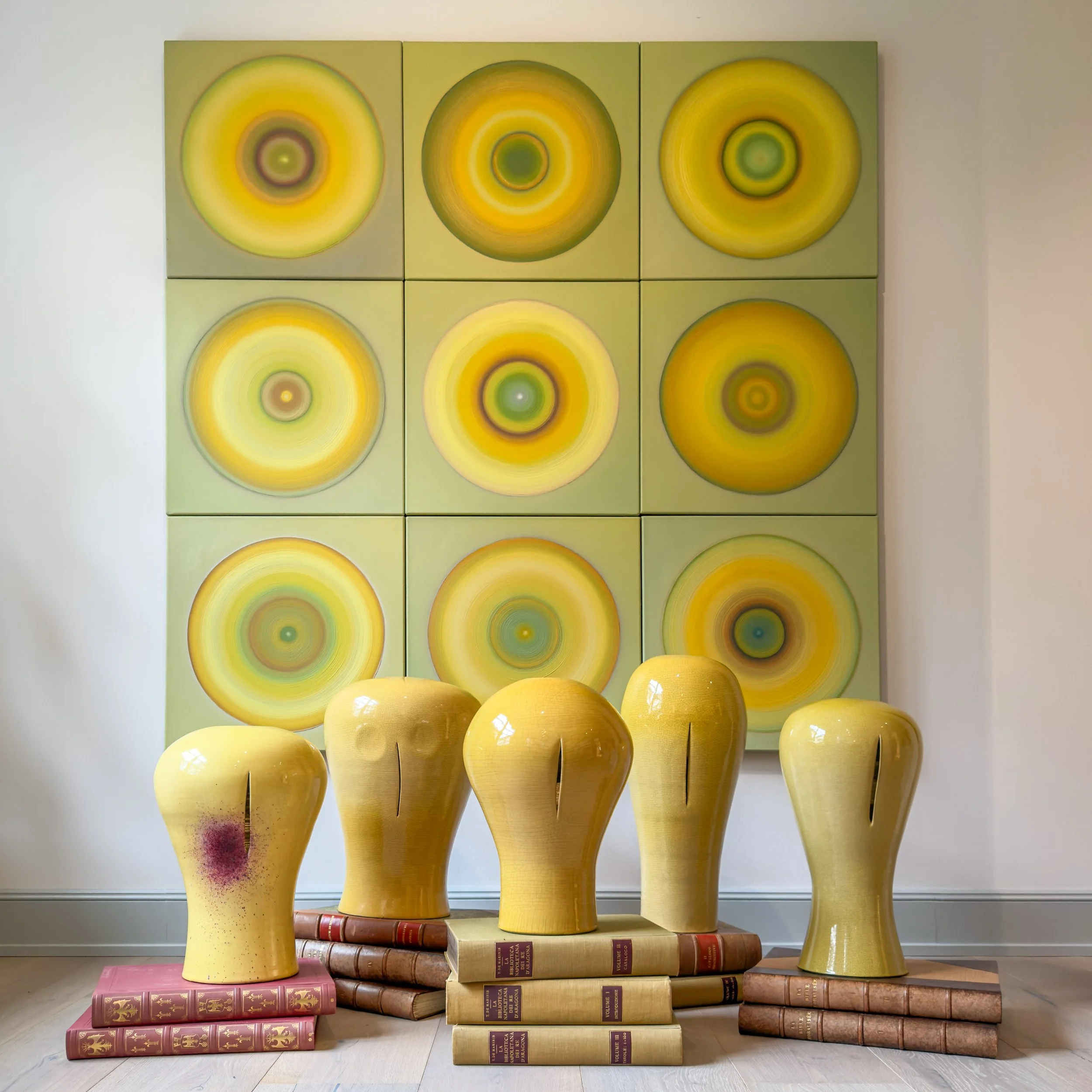
Paintings:
Core No. 545 - 554, 2022, Oil on Canvas
Ceramic Sculptures, left to right:
Core No. 2055, Core No. 2065, Core No. 2054, Core No. 2060, Core No. 2050
2025, Ceramic, Celadon Glaze, Gold
A Sculptural Cosmology
Taken together, Günther’s ceramic works form a sculptural cosmology - an evolving constellation of poetic experiments that speak to humanity, perception, and transformation. She imagines future groupings of abstracted, quasi-figurative forms that operate symbolically, even liturgically. These works are not narrative, but relational. They transmit energy through proximity, alignment, and repetition.
In conclusion, Günther’s ceramic works signal a practice in motion rather than a settled position. They sustain an inquiry open to transformation, shaped by material discovery, spatial encounter, and the contingencies of making. Meaning emerges gradually, inviting an engagement grounded in resonant attentiveness rather than interpretation alone. Working with clay - a medium marked by history, risk, and irreversibility - Günther advances a sculptural language that balances continuity with innovation, demonstrating how ancient materials can remain responsive to contemporary thought and lived experience.
17/01/2026